 Creade
How To Do Curls With A Hair Dryer And Round Brush
0Learn How To Curl Hair With A Blow Dryer And Round Brush, Set Loose Waves With Cool Air, And Use A Diffuser To Keep Your Natural Curls Defined As They Dry.
View detailsSearch the whole station
The ion blower may still be injured. The “ion” function does not offset the risk posed by high temperature, close proximity or repeated exposure to the same location. To judge whether an ion blower is mild, it is necessary to see how it controls the heat when it is actually used; the conclusion of “no wound” cannot be reached only with a negative ion mark. The American Society for Skin Diseases has also made it clear that overheating can damage hair and recommends the use of low or moderate temperatures and the use of heat protection products. Source: American Society of Dermatology.
As to whether the ion function itself is damaging to hairlines, the studies and product tests reviewed here are not sufficient to make such a causal determination. Similarly, this information does not prove that all ion blowers are better protected than ordinary ones. Let’s see what they’re doing.
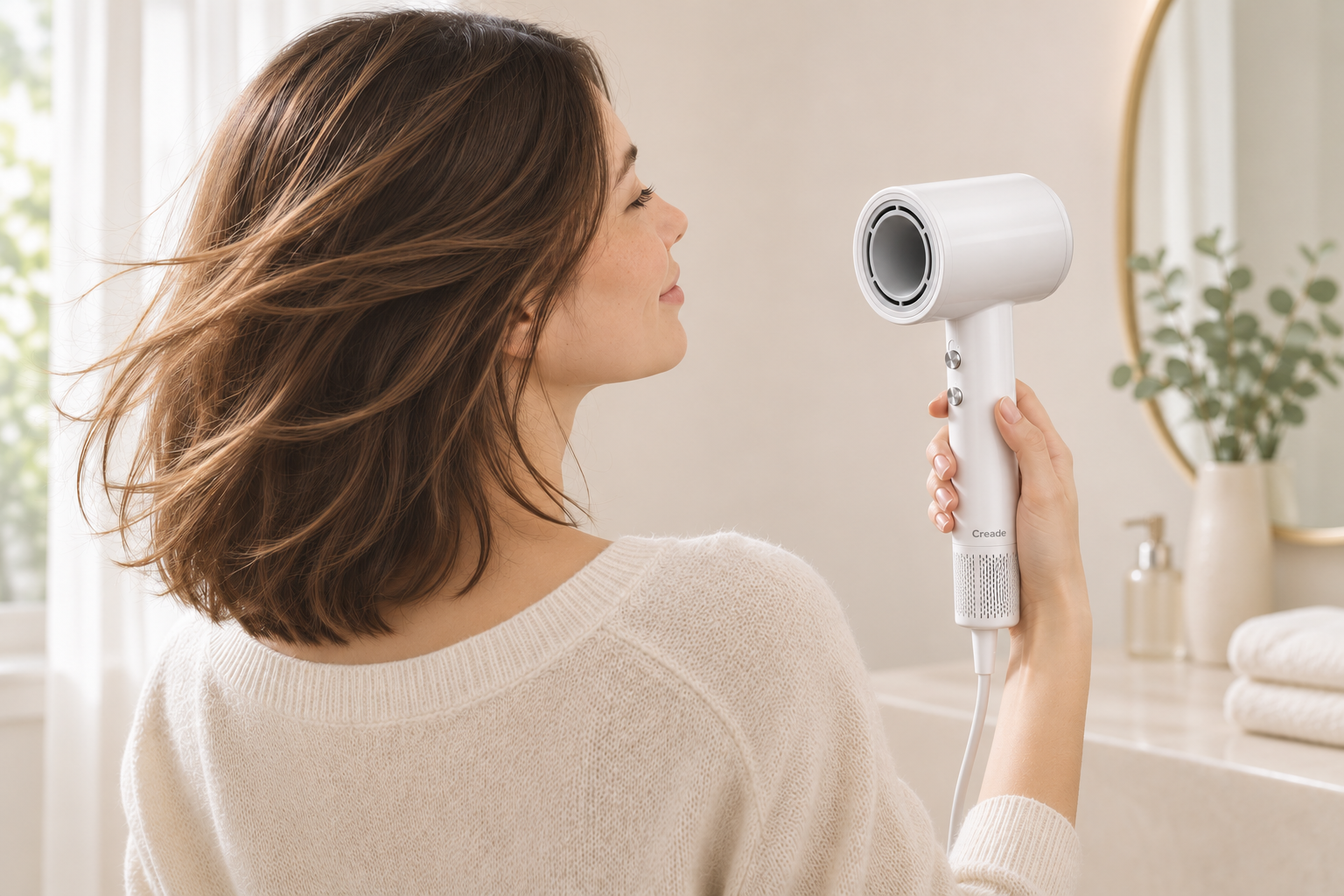
The term “ion” in an ion blower is usually used to refer to the negative ion produced by the equipment and released in the air stream. The Hong Kong Consumer Council explained that the negative ion may have a positive charge on the surface of the hair, which temporarily improves the disassembly caused by static electricity and makes it easier to comb the hair; this change does not mean that the hair surface has been repaired. Source: Hong Kong Consumer Council
Sliding and structural damage are two different judgments.
The fact that the hair is more adhesive after the blow may indicate a change in the formative behaviour, but it cannot be shown separately that there has been a decrease in the damage to the mast. Conversely, the replacement of an ion blower does not feel the roots are loose enough, nor can it be assumed that it is damaged by this phenomenon alone. The appearance, hand and degree of injury need to be observed separately.
This also explains why “reduced impatience” cannot be replaced directly by “rehabilitated damaged hair”. The former describes the effects of use, while the latter relates to silking structures and requires corresponding test support.
The ion generator did not remove the wind blower from the hot wind dry process. Thermal damage is judged by the temperature to which the hair is exposed, the distance of the wind mouth and how long the same part is blown.
A study published in Annals of Dermatology in 2011 carried out 30 washing and drying of beams, three of which were carried out under the following conditions:
The distance between wind mouths and beams.
| 15 cm | 47 °C | 60 seconds |
| 10 cm | 61 °C | 30 seconds |
| 5 cm | 95 °C | 15 seconds |
The higher the temperature, the more visible the filament surface damage was observed. Nearer and hotter groups have experienced more severe surface damage, albeit for shorter drying periods. Source: Lee et al., 2011
This set of data indicates that it blows fast and cannot be shown to be milder alone. It is also important to determine whether the reduction in time is achieved by increasing temperature and reducing distance.
These values also have boundaries. The experiment changed distance, temperature and time, and the damage caused by each factor cannot be calculated separately, let alone 47 °C or 15 cm as the safety limit applicable to all equipment, hair and wind mouths. The study also failed to compare ion opening and closure and could not be used to demonstrate the protective effects of ion function.
That can’t be inferred.
The Hong Kong Consumer Council tested 13 blowers in 2023, all claiming to have negative ion functions, but measured concentrations varied widely; one of them measured only 361 negative ion/cm3, close to the level of the non-negative ion function control in the test. Some samples were also found to have a maximum vent temperature of more than 96°C at a given test distance. Source: Hong Kong Consumer Council product testing
There is no automatic correspondence between “with an ion function” and “lower winding temperature”. The ion concentration measure answers how much of the ion was released by the equipment, and it does not respond directly to how much heat the filament bears or how much damage was caused by repeated drying.
When reading the product description, three types of claims should be checked separately:
For branders, importers and distributors, these differences directly affect the accuracy of the product documentation. The ion detection report can support the ion output description; evidence corresponding to the result is required for “reduce break” or “rehabilitation of masts”.
Once the ion function has been activated, basic thermal protection steps still need to be retained.
Take the water with a towel or a soft T-shirt, and don’t push back and forth. This deals with moisture and friction before drying; the American Society of Skin Diseases also recommends mild water intake to reduce damage caused by rough drying. Source: American Society of Dermatology Recommendations
Now, focus on the actual blowout:
If the switch is followed by a continuous rough, visible break or fork, the temperature of the old and new equipment, the distance of use, the drying time, and whether or not the nursing product has been burned or replaced during the same period. The cause of the damage could not be identified simply by the change in “to an ion blower”. There is no improvement in the way care is adjusted, or the hair is thin and hair is removed at the same time, and the dermatologist should be consulted. Source: American Society of Dermatology.
Ion blowers can function to improve electrostatic performance while the risk of heat damage remains. In the evaluation, it was determined whether it was able to dry up under more moderate settings and then check the basis for testing the ion effects. The smoothness of the blow is worth recording; whether the damage is reduced requires additional proof.
Learn How To Curl Hair With A Blow Dryer And Round Brush, Set Loose Waves With Cool Air, And Use A Diffuser To Keep Your Natural Curls Defined As They Dry.
View details
Is An Ionic Hair Dryer Good For Fine Hair? Learn How Ion Settings Affect Smoothness And Volume, Why Heat Control Matters, And How To Compare Results At Home.
View details
The Most Immediate Benefit Of An Anion Hair Dryer Is That It Reduces Flyaways Caused By Static Electricity. After Brushing Dry Hair, The Flyaways On The Crown
View details
Find The Best Blow Dryer For Frizz. Compare Heat Control, Airflow And Attachments For Fine, Thick Or Curly Hair, And Learn How To Evaluate Anti-Frizz Claims.
View details