 Creade
Did the ions blow your hair? Distinguishing ions from heat damage.
0Can An Ionic Hair Dryer Damage Hair? Learn How Ions Differ From Heat Exposure, What Drying Studies Show, And How Temperature, Distance, And Time Affect Risk.
View detailsSearch the whole station
The search for “blow dryer that doesn’t damage hair” depends first on whether the wind blower is able to dry at a lower temperature and whether it needs to be used close to the hair and repeatedly heat the same part. It is not possible to confirm that a machine will not be injured under all conditions of use by a few names of “negative ion” “high speed” or “smart temperature control”. The American Dermatology Society has specifically warned that any hair mass may be damaged by excess heat and has recommended the use of heat control tools and the use of low or medium temperature settings. Source: American Society of Dermatology Recommendations
Therefore, the selected operator needs to answer a more specific question: What functions can help to reduce unnecessary heat exposure and what are the functions that use boundaries?
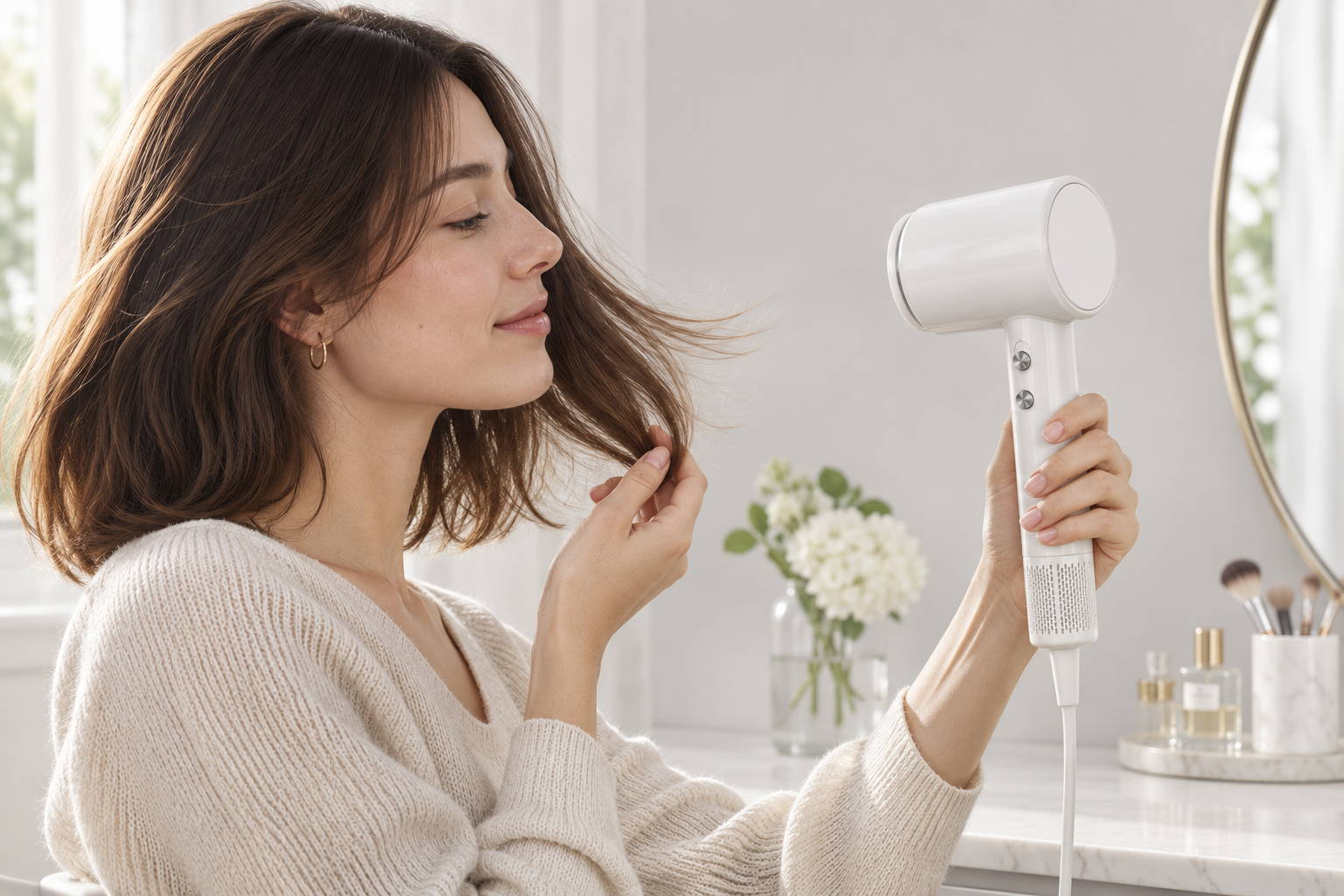
The drying time is worth comparing, but the effects of the care cannot be judged separately.
An experiment of hairlines published in Annals of Dermatology in 2011 carried out 30 washing and drying of hair. Three of these groups are subject to the following conditions: distance 15 cm, 47 °C, 60 s; distance 10 cm, 61 °C, 30 s; distance 5 cm, 95 °C, 15 s. The damage to the surface of the hair was observed to increase with the increased temperature. In other words, in this group, the shortest drying time did not result in the slightest surface damage. Source: Lee et al., study of wind temperature and dry time
There is a limitation: the experiment changes distance, temperature and time at the same time, and it cannot be used to calculate how much damage a factor alone contributes, let alone to use one of the temperatures as a general safety cap for all hair.
Its practical significance for the selection machine is to ask what temperature, distance and accessories are used when comparing “minutes dry”. The speed of close proximity cannot be directly equated with low-temperature dry efficiency.
The cryogenic stage requires physical drying.
If the machine reduces the temperature only at the same time by significantly reducing the wind speed, the user may be able to cut back in time. Temperature and wind velocity can be adjusted separately, making it easier to keep the required flow while reducing heating. This is the reason for a more controlled design and does not mean that the wind speed is higher and more protective.
On a trial basis, the temperature can be selected and the wind speed adjusted step by step. See if hair is stable and dry, and if the currents cause obvious entanglements that need to be combed over and over again. Suitable to their own combinations should meet both drying and operational needs.
When you see a temperature campaign, you look for sensors to monitor objects and control methods.
The machine monitors temperature 40 times per second and gives feedback to microprocessors, for example, in the official note by Dyson Supersonic Origin. This description refers to the temperature feedback mechanism; it does not indicate that the machine directly measured the temperature of each hair. Source: Dyson Official Product Description
When comparing different types, it is worth checking:
Monitoring frequency is only one of these parameters. Only “more detections per second” would make it impossible to conclude that the whole machine had fewer injuries and that temperature control performance and corresponding beam tests were required.
These parameters answer different questions. They are all classified as “care indicators” and can be miscalculated.
The functions or parameters on the page can be used to understand what needs to be checked.
Dyson officially describes the role of its negative ion as contributing to the reduction of electrostatic power, with a separate description of the temperature control function. The two tasks are not the same. The effect of blowing a hair can be useful, but this does not in itself prove that no heat damage has occurred. Source: Dyson Official Specifications and Functional Description
The same method of judgement should be applied for power and velocity: they are product parameters and are not measurements of hair damage. If both machines claim to be “high-speed cryogenic”, a comparison should be made between dry performance under the same conditions rather than the largest number on the page.
“No heat damage” has evidentiary value, but the scope of the test must be retained.
For example, ghd’s official statement on Duet Blowdry’s hair is conditional on 100 cycles, four times per cycle, in which no heat damage is detected. FAQ, its professional channel, further explained that the tests compared the filament intensity before and after use and did not detect a significant decrease in intensity. Source: ghd official statement, ghd professional channel test note
This means that at least three things are to be distinguished when reading the statement:
Test what. Thin strength, surface morphology, fracture and glossy are different indicators, and one item has not changed significantly and cannot automatically cover the others.
How to use it. Operation after full ingestion is different from operation under a drip; the number of passages is different from the length of stay.
What kind of tools were tested. Wind-brushing combs with heating surfaces, unlike common hand-held blowers, cannot directly apply each other ‘ s test findings.
For branders or importers, matching model testing methods, arming status, operating cycle, control conditions and outcome indicators should be required to assess the statement. It is not enough to judge whether the statement can be used for its own products.
Once the machine is selected, the process will change the outcome.
First with towels or T-shirts to suck water softly, and then avoid pushing back and forth. The American Dermatological Society also recommends the reduction of heat exposure and the use of suitable heat protection products; such products should be self-described and should not be used as a justification for continuing high temperature operations. Source: American Society of Dermatology Recommendations
Start drying and keep the wind blowers moving. The BaBylisspro Portofino ‘ s use instructions clearly require that the concentration of heat on the same part of the hair be avoided in order to reduce excessive drying and possible damage. Their mouths are used to concentrate the air stream in small ranges, so that, when using the attachments, care is also taken about local presence. Source: BaylissPRO Official User Note
The 15 centimetres in the aforementioned study should also not be understood as “absolutely safe at this distance”. Different structural variations were found: surface damage was more pronounced in the blow-winding group, while damage to cytofilm complexes occurred in the natural drying group. It does not demonstrate on this basis that day-to-day blowing is always better than natural drying, nor does it provide uniform distance for all machines. Source: Lee et al.
The operation should be combined with a description of the corresponding model to avoid closeness and fixed heating. There is no need to continue to accept hot winds to wait for other regions to dry.
When sifting a wind blower, three questions can be examined: whether the required drying can be completed at low temperatures, whether the temperature and wind speed can be easily adjusted, and whether the protective declaration meets the test conditions.
If the product provides only negative ion quantities, electric velocity and “zero damage” slogans, the information continues. A further comparison is justified if the manufacturer can indicate the temperature control object, the actual drying conditions and the results of the beaming tests.
The objective should be specific: to reduce unnecessary high temperatures, close heating and repeated operations, provided that drying and configuration can be completed. In this way, the function of selection can be used.
Can An Ionic Hair Dryer Damage Hair? Learn How Ions Differ From Heat Exposure, What Drying Studies Show, And How Temperature, Distance, And Time Affect Risk.
View details
The Most Immediate Benefit Of An Anion Hair Dryer Is That It Reduces Flyaways Caused By Static Electricity. After Brushing Dry Hair, The Flyaways On The Crown
View details
Is An Ionic Hair Dryer Good For Fine Hair? Learn How Ion Settings Affect Smoothness And Volume, Why Heat Control Matters, And How To Compare Results At Home.
View details
Find The Best Blow Dryer For Frizz. Compare Heat Control, Airflow And Attachments For Fine, Thick Or Curly Hair, And Learn How To Evaluate Anti-Frizz Claims.
View details